Germany
First Dive in the Third Wave
The “Third Wave of Coffee” is a name identifying the birth of a number of coffee houses with their own roasteries, attempting to provide artisanal coffee with a high quality and a strong differentiation in terms of taste, opposed to the standardization and mass production of industrial coffees. Given the recent development of this phenomenon, only time will tell us whether it constitutes a real development of coffee culture, or just a marketing strategy for coffee houses. Probably both components are present at a varying degree.
The term was born in an American context in the early 2000s, where the First Wave started with the early diffusion of roasted and ground coffee ready for brewing. Until the 1850s each American household would buy its own green beans and prepare them. This was actually the traditional way to prepare coffee both in Europe and in America and the Third Wave seems to recover some elements from it. One difference we noticed is that the Third Wave coffees seems to priviledge single-sourced beans versus blends: while it allows to get familiar with the taste from each country of origin, we are not sure this is an objectively superior alternative, as it is normally sold. There is no such thing as the contraposition between a “pure” single sourced coffee and an “impure” blend; in our view there is just good taste versus bad taste, and on the contrary blending various varieties of coffee is a good way of experimenting, as well as a practice present since the beginning of the coffee tradition.
| Traditional Coffee: a voice from XIX century Italy
[Ho una casa mia! by Tommasina Guidi, Turin 1879] My mother meanwhile had stood up, we did the same, and moving to the nearby patio, we took coffee. Coffee always had the greatest attention from my mother and I suppose it is not useless for me to dedicate one whole page to coffee, recalling all I heard from her about this precious drink. One of the fundamental conditions for coffee to be good is its age. When it is too new, it is acrid and far too exciting; by aging, it loses this defect, and under this aspect, my mother likens it to wine. Experts prefer very green coffee with round taste. Mocha quality of coffee is the best one. It is seldom available even in shops selling colonial goods, but it is very easy to find good coffee of the Bourbon quality, with its delicious aroma. The Martinica quality is stronger and more exciting than the ones already mentioned; it also needs to be aged more in order to develop its good taste. Coffee is, I believe, one of the few supplies that my mother stores in huge quantities; she keeps it in a dry place, withdrawing some to have it roasted, half Martinica, half Haiti, and she mixes them before grinding it. In order to obtain a pleasant coffee, it has to be burnt just a bit; it should not be black but red. As soon as it is roasted, mom puts it into a jar or a well-sealed box and grinds the minimum quantity suitable for the consumption each time we drink. Special care must be taken, not to store coffee in a smelly container, and not to put it next to an object with even the slightest perfume, otherwise coffee will for sure absorb it and lose its taste. Engineer Francis, enjoying the coffee cup I gave him, told my mom: – The compliment is trivial, he said, but I cannot abstain from making it. In your house, people eat and drink deliciously, and as a sigil (so to say) of this excellent experience I am enjoying an inhebriating coffee. My mother accepted with satisfaction the words of our banqueter. The first order she gives to a new servant or maiden is to prepare coffee. She recounted to Mr. Francis how, for many years, she used to prepare coffee herself on the dining table; but a very sad accident disgusted her so much, that she lost all pleasure in attending to that matter, pertaining to the housewife. As a little girl, I was dancing around the table; quickly trying to grab a sweet, I hit with my arm the “cuccuma” [Note: Neapolitan flip coffee pot] and hot water spilled on my shoulder. Needless to say, my mother turned pale while talking. Mr. Francis, while praising the fragrant drink, which he was tasting one sip at a time, with familiar intimacy that my mother had already authorized, recalled when, in the beginning of the XVIII Century, Capt. Declieux took three small plants from the King’s garden and brought them to the Americas, where the production of coffee is nowadays generating a yearly revenue of six hundred millions [Note: 1879 Italian Liras, between 4.5 and 5 billion euros in 2015]. The journey of Capt. Declieux was utterly long and dangerous; at some point, water was scarce and he had to use his own ration to keep the three plants alive. Only one survived, and from that one… Divine Providence! my mother exclaimed, all the plants in the Antilles and the tropical region of the greater America descended. After listening to with pleasure the tale narrated by the engineer, my sister-in-law stood up, walked out, on the lawn, and I followed her. The early moonlight was gently illuminating the night. |
This “First Wave” is a worldwide phenomenon.
The Second Wave was the diffusion of the coffee roasters and retailers such as Starbucks and Peet’s, and is typically North American. There is no equivalent in Italy, for example, where local roasters compete together with the most famous brands (suchas Illy, Lavazza, Segafredo, …) and the coffee shops (“bars”) are privately owned and not part of franchises.
As relative new comers into the world of coffee, we discovered the Third Wave in Berlin.
It was our last day in our visit to the German capital and we dedicated some time to explore “The Barn” (Schönhauser Allee 8, 10119 Berlin).
After a pleasant but cold (-10ºC!) walk through the Mitte neighborhood, we were welcomed with kindness and ordered our espressos, prepared with a Kenyan Arabica coffee. The strong taste was a wake-up call for our frozen senses and, even if its bitterness does not make it our favourite, its personality make it very interesting and we have all the intentions to come back once we will have more elements and experience to evaluate it.
The Barn itself has been undoubtedly established by coffee lovers and if you are in the area we advise you to pay them a visit. They roast their own coffee, as detailed on their website.
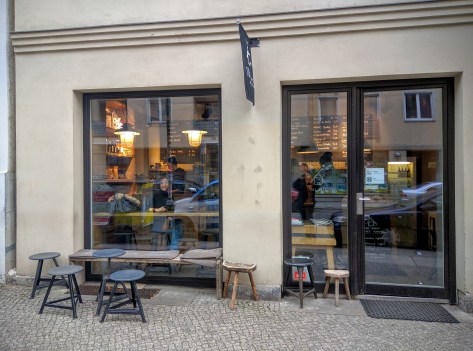
The Barn
The second place we visited was Distrikt Coffee (Bergstrasse 68, 10115 Berlin), also in the Mitte neighborhood, less than a 20 minutes walk away from The Barn and close to the Berlin Wall Memorial.
As far as we know, they do not roast the beans but use quality product from European makers, such as Workshop Coffee from the UK.
Compared to the Barn, they appear to be less specialized in coffee but offer a great variety of sweets and food, which makes them ideal for breakfast.There is more room to sit and enjoy and they offer complimentary wi-fi, which makes them popular with students, as we could verify, and generally as a place to meet and hang out.
We tried a Colombian Arabica espresso accompanied by their signature bread pudding,which formed a perfect match. The pudding itself was delicious and a wonderful side-kick to the round and decise taste of the coffee.
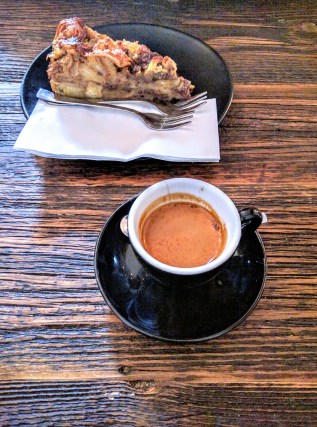
Distrikt Coffee
 COFFEE MAPPING