Coffee
Pasticceria Colombo
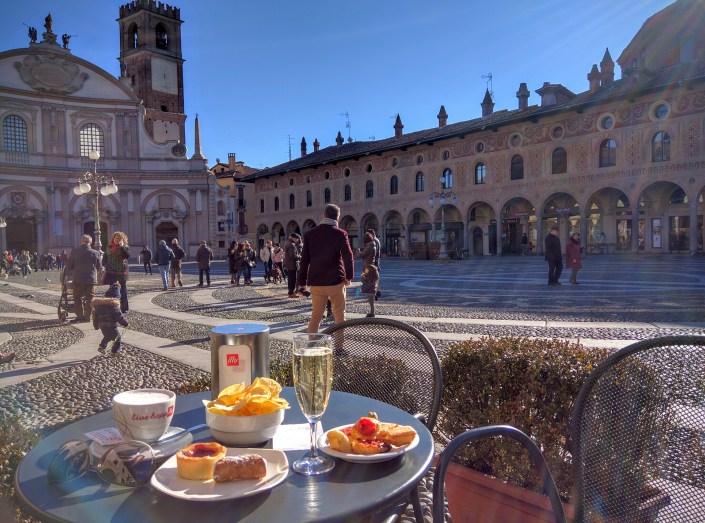
My first review for the coffee shops in Vigevano starts with one of the pastry shops in the famous square of the city, Piazza Ducale.
When you enter the square, you see lots of attractive options for coffee and snacks! As the locals suggest, I recommend to make a turn around the square area to see the best places according to your taste. Or as I do, you can try one by one to check all of them 🙂
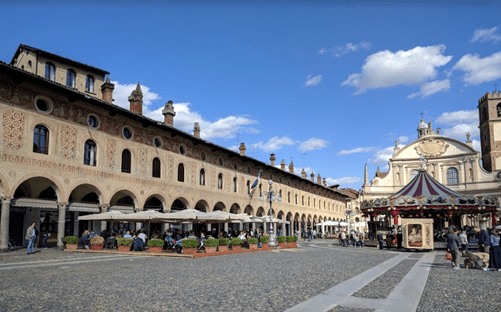
For the first review, I wanted to start with one of my favorite pastry and coffee shops. Since the offering for both sweets and coffee-based drinks is so varied, if you become a regular you can try limitless combinations!
Another benefit of becoming a regular is of course the opportunity to benefit from the warm welcome of the staff.
Some key information about the coffee
- The coffee brand that they use is Illy.
- I have seen at their door a statement that they have good evaluation for the coffee preparation Since the place is usually full, I can imagine that the coffee is quite fresh with respect to the average shop.
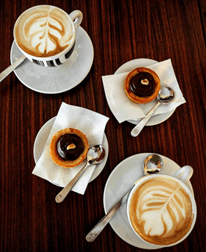
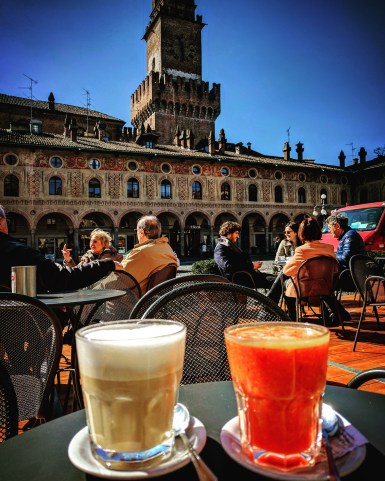
The cappuccino is quite fluffy J you feel the smooth taste of coffee ugh milk and not coffee dominated.
If you want your coffee to last longer and if you enjoy the taste of the milk in your coffee, I recommend you to order latte macchiato, which is served in a bigger glass.
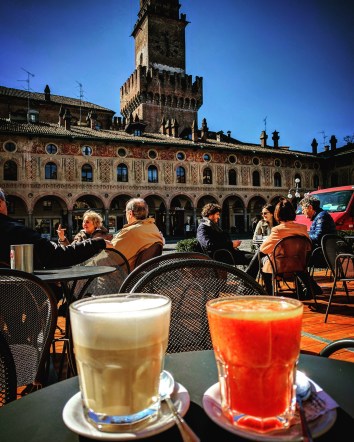
During the good weathers, it is a very good idea to with outside (be aware that you need to pay more when you sit outside or inside. This is a common rule in Italy) and enjoy the view of square, old church and castle.
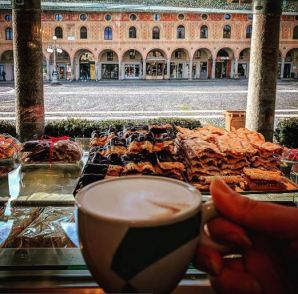
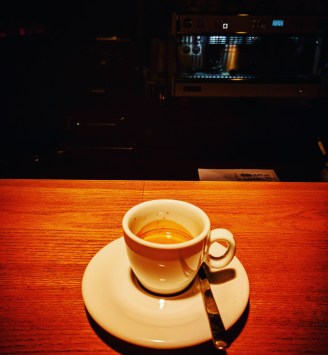
If you already have hurry and just want to enjoy a good coffee and continue to walk around, the coffee at the desk can be also a good option.
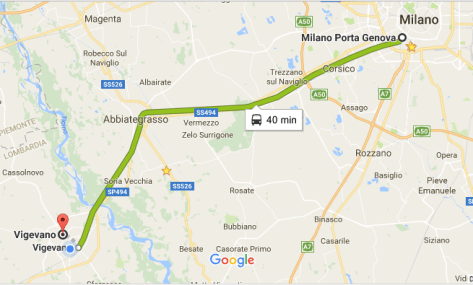
WHERE: Vigevano, Northern Italy, 35 km (21 miles) South-West of Milan
HOW: the town is connected to Milan (Porta Genova station) by a railway arriving at a short distance from the square. Parallel to the railway there is a road, allowing you to reach the town by car
WHEN: Spring, Summer and Autumn allow to benefit from perfect conditions outside. Sunny Winter days are also a good choice. The town deserves at least half a day visit.
My Journey to explore coffee
As a regular coffee drinker, I have always been thinking to addend a coffee course, to increase my awareness on the drink that i love. At last I had time and opportunity to do that! I can say that it was a wonderful opportunity and it turned out to be the best way to begin gathering info and experience!
It started with cupping, sensory training and the transformative journey of the coffee beans, from the plant to our cups.
During the training, I realized again that even though coffee looks quite a regular and simple drink, a lot of complicated factors intervene to change its quality and taste, since the blossoming of a plant in the plateaus of tropical countries till the final serving in some coffee house .
I also learnt that a lot of the coffee that we drink is actually low quality and poor taste compared to the potential of the drink itself.
- The source of the beans, the degree of the roasting, the fresh grinding just before you drink and how you brew is very important and it can completely alter the taste of the coffee that we are drinking.
When we were going back home after the coffee course, we had quite different emotions about the fresh information that we received. From one side it provided us with more awareness and indications to explore more about the drink but from time to time I think that ‘ignorance is bliss’. Because the more you think about the taste of a good coffee, the less you enjoy your daily coffee. That is why we decided to seek for alternative solutions to improve our daily coffee drinking. I am dedicated to seek enjoyable coffee shops with good coffee and ambiance.
I am sure it will be a long and enjoyable journey for me, but I am happy to start my discoveries, with coffee as a companion 😊
Arabic or European or American Style?
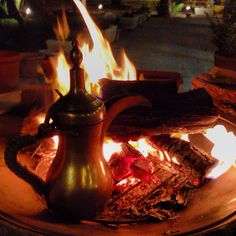
It is no longer the time of coffee prepared on a camp fire, under a starry night in the desert 🙂 So nowadays international hotels and restaurants in the dynamic UAE offer mainstream European or American style brew, with good quality but not much of a local perspective.
I expected to see more traditional style coffee: maybe similar to Turkish coffee, but certainly different from EU or USA style. Given the fact that coffee was originally spread from Yemen according to a lot sources, it was very interesting to see that the touristic places I visited kept no memory of its history.
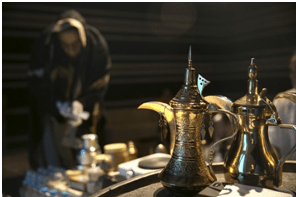
That is what I expected before traveling 🙂
Since I had limited time (I was there working) I could not dive deep into local coffee culture, made of artisanal roasters and a variety of coffee shops-. The places where I have been did not have many choices. Most of the time, the menu was limited with espresso, its varieties and american coffee. I started with American coffee.
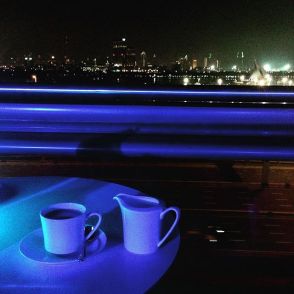
The result was not as I expected. I can not say that the coffee tasted bad but there was no trace of special taste of arabic coffee. My second trial (apart from the coffees that I drank during the day) was at an italian restaurant in the marina. That I is why I checked espresso this time. The coffee was very similar that you can find regularly in Italy. With the view, I can say that it was enjoyable and worth to try 🙂
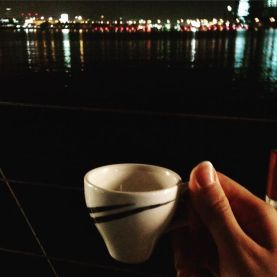
My espresso with the view
In the end, I regretted leaving the UAE without experiencing the traditions of a place so close to Yemen, the cradle of coffee. On the other hand, I am also sad because the local traditions could not penetrate the walls of hotels and restaurants for foreigners, which remain limited to European or American type of brew.
I had a physical journey, but I could not make a journey in coffee: not much changed between Berlin, Houston or Dubai
This standardization of the offering seems to me a form of self-censorship rather than an actual need, because tourists and travelers may definitely be interested in tasting something different. I hope the local coffee culture will one day proudly manage to take its place, next to the espressos and filtered coffees on the menu of any kind of venue! The richness comes when you integrate different cultures 🙂
Image credits:
1st Image: http://www.thenational.ae/opinion/editorial/uaes-coffee-culture
2nd Image: https://it.pinterest.com/maktabicarpets/qahwah-love-arabic-coffee/
Other two images are mine
So sweet!
When you love the whole “Coffee family”, and find a Starbucks every mile (yes not km but mile 🙂 ), you are inevitably tempted to stop the car and drink some! It was one of those days, when it felt like Starbucks was waiting for us 🙂
This time I wanted to start my morning with a newspaper, a white chocolate mocha instead of cafe latte and a chocolate cake. Even though I was thinking that I can eat unlimited amount of sweets, the combination was too sugary for me.
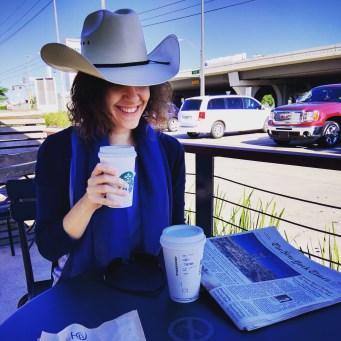
In any case, I was happy 🙂
The calorie level of mocha (size tall: 350 kcal) was double the level of caffe latte (size tall: 150-160) but I was not expecting a sweet combination like this one because I had drank mocha elsewhere in the world around Europe and in Turkey (and afterwards even in Dubai). It reminded me of the articles that I read some months ago about the sugar levels in different drinks and I decided to take a look again.
I have found the article in Business Insider but the size was not the one that I drank. I switched to the original source, which is ‘Action on Sugar’ and found out that I had drank already 11 spoons of sugar (just from coffee). Apperantly it is around 177% of the daily intake that is recommended by the World Health Organization. The official announcement of Starbukcs about this issue was:
“Earlier this year we committed to reduce added sugar in our indulgent drinks by 25% by the end of 2020,” a Starbucks representative told Action on Sugar. “We also offer a wide variety of lighter options, sugar-free syrups, and sugar-free natural sweetener, and we display all nutritional information in-store and online.”
I can say that 25% reduction is not enough but it can be a start. I hope they will be able to find healthier solutions with less amount of sugar in the future. I want to continue to try different drinks based on coffee, but they should be healthier, so we can live more and enjoy more coffee 🙂
Home Roasted Coffee? Here is an alternative…
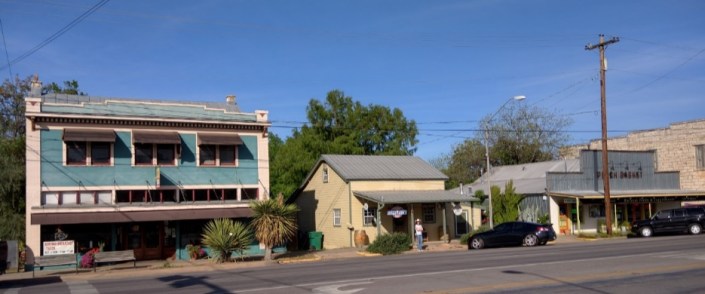
We had planned our visit to see Enchanted Rock State Natural Park, later deciding to include Frederiksburg, which is 8,4 miles (13,5 km) from the natural area. When we arrived to the historical neighborhood, I was nearly losing my hope to find a coffee roaster around.
There were no popular coffee chain on Main Street, and we did not know what we could expect. Then I had chance to taste american coffee at the Crossroads Steakhouse & Saloon and actually the taste was better than I had imagined. With the friendly service that they have, it was a pleasant experience.
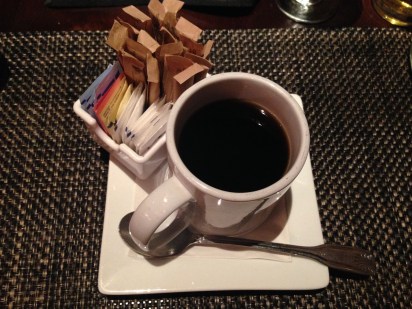
Of course we did not give up to search for a specialized coffee place and at the end, with the help of social media, we found it!
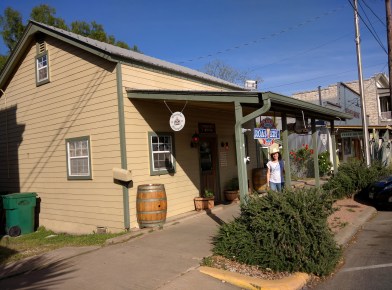
Even though the town has a population of 10,5k (year 2010) according to Wikipedia, I was suprised and happy to see a roaster called ‘Ranch Road Roasters’. When we found it, it was already closed, so I waited for the next day to taste a home roasted coffee.
When we came back next day, we asked for the coffee of the day, which turned out to befrom Guatemala. We took our coffee and continued to the small garden on the back for a peaceful coffee tasting.
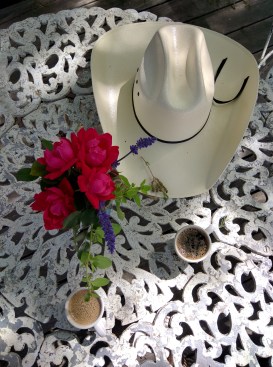
The taste was lighter than we expected, also beacuse of the size of the serving. Even though they use espresso size cups, they filled them so that the coffee ended up being diluted. As a result, it was easier and lighter to drink. As an Italian style espresso, it might have been a bit too strong for us. The person, who prepared our coffee, told us that all coffee there is roasted by them and we also saw the roasting equipment they have (as well as the white smoke from the chimney outside, when we left). Overall, we were happy about our experience and ready to go back in the future, should we have an opportunity. The person working was very kind and treated us with the same warmth, as if we were regular customers.
I can say that if the small town is on your way and if you crave for a home roasted caffein punch, the place can be an option for a trial.
First Dive in the Third Wave
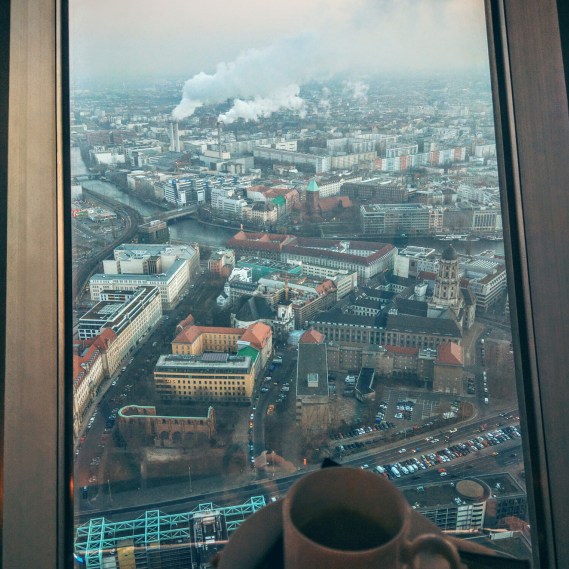
The “Third Wave of Coffee” is a name identifying the birth of a number of coffee houses with their own roasteries, attempting to provide artisanal coffee with a high quality and a strong differentiation in terms of taste, opposed to the standardization and mass production of industrial coffees. Given the recent development of this phenomenon, only time will tell us whether it constitutes a real development of coffee culture, or just a marketing strategy for coffee houses. Probably both components are present at a varying degree.
The term was born in an American context in the early 2000s, where the First Wave started with the early diffusion of roasted and ground coffee ready for brewing. Until the 1850s each American household would buy its own green beans and prepare them. This was actually the traditional way to prepare coffee both in Europe and in America and the Third Wave seems to recover some elements from it. One difference we noticed is that the Third Wave coffees seems to priviledge single-sourced beans versus blends: while it allows to get familiar with the taste from each country of origin, we are not sure this is an objectively superior alternative, as it is normally sold. There is no such thing as the contraposition between a “pure” single sourced coffee and an “impure” blend; in our view there is just good taste versus bad taste, and on the contrary blending various varieties of coffee is a good way of experimenting, as well as a practice present since the beginning of the coffee tradition.
| Traditional Coffee: a voice from XIX century Italy
[Ho una casa mia! by Tommasina Guidi, Turin 1879] My mother meanwhile had stood up, we did the same, and moving to the nearby patio, we took coffee. Coffee always had the greatest attention from my mother and I suppose it is not useless for me to dedicate one whole page to coffee, recalling all I heard from her about this precious drink. One of the fundamental conditions for coffee to be good is its age. When it is too new, it is acrid and far too exciting; by aging, it loses this defect, and under this aspect, my mother likens it to wine. Experts prefer very green coffee with round taste. Mocha quality of coffee is the best one. It is seldom available even in shops selling colonial goods, but it is very easy to find good coffee of the Bourbon quality, with its delicious aroma. The Martinica quality is stronger and more exciting than the ones already mentioned; it also needs to be aged more in order to develop its good taste. Coffee is, I believe, one of the few supplies that my mother stores in huge quantities; she keeps it in a dry place, withdrawing some to have it roasted, half Martinica, half Haiti, and she mixes them before grinding it. In order to obtain a pleasant coffee, it has to be burnt just a bit; it should not be black but red. As soon as it is roasted, mom puts it into a jar or a well-sealed box and grinds the minimum quantity suitable for the consumption each time we drink. Special care must be taken, not to store coffee in a smelly container, and not to put it next to an object with even the slightest perfume, otherwise coffee will for sure absorb it and lose its taste. Engineer Francis, enjoying the coffee cup I gave him, told my mom: – The compliment is trivial, he said, but I cannot abstain from making it. In your house, people eat and drink deliciously, and as a sigil (so to say) of this excellent experience I am enjoying an inhebriating coffee. My mother accepted with satisfaction the words of our banqueter. The first order she gives to a new servant or maiden is to prepare coffee. She recounted to Mr. Francis how, for many years, she used to prepare coffee herself on the dining table; but a very sad accident disgusted her so much, that she lost all pleasure in attending to that matter, pertaining to the housewife. As a little girl, I was dancing around the table; quickly trying to grab a sweet, I hit with my arm the “cuccuma” [Note: Neapolitan flip coffee pot] and hot water spilled on my shoulder. Needless to say, my mother turned pale while talking. Mr. Francis, while praising the fragrant drink, which he was tasting one sip at a time, with familiar intimacy that my mother had already authorized, recalled when, in the beginning of the XVIII Century, Capt. Declieux took three small plants from the King’s garden and brought them to the Americas, where the production of coffee is nowadays generating a yearly revenue of six hundred millions [Note: 1879 Italian Liras, between 4.5 and 5 billion euros in 2015]. The journey of Capt. Declieux was utterly long and dangerous; at some point, water was scarce and he had to use his own ration to keep the three plants alive. Only one survived, and from that one… Divine Providence! my mother exclaimed, all the plants in the Antilles and the tropical region of the greater America descended. After listening to with pleasure the tale narrated by the engineer, my sister-in-law stood up, walked out, on the lawn, and I followed her. The early moonlight was gently illuminating the night. |
This “First Wave” is a worldwide phenomenon.
The Second Wave was the diffusion of the coffee roasters and retailers such as Starbucks and Peet’s, and is typically North American. There is no equivalent in Italy, for example, where local roasters compete together with the most famous brands (suchas Illy, Lavazza, Segafredo, …) and the coffee shops (“bars”) are privately owned and not part of franchises.
As relative new comers into the world of coffee, we discovered the Third Wave in Berlin.
It was our last day in our visit to the German capital and we dedicated some time to explore “The Barn” (Schönhauser Allee 8, 10119 Berlin).
After a pleasant but cold (-10ºC!) walk through the Mitte neighborhood, we were welcomed with kindness and ordered our espressos, prepared with a Kenyan Arabica coffee. The strong taste was a wake-up call for our frozen senses and, even if its bitterness does not make it our favourite, its personality make it very interesting and we have all the intentions to come back once we will have more elements and experience to evaluate it.
The Barn itself has been undoubtedly established by coffee lovers and if you are in the area we advise you to pay them a visit. They roast their own coffee, as detailed on their website.
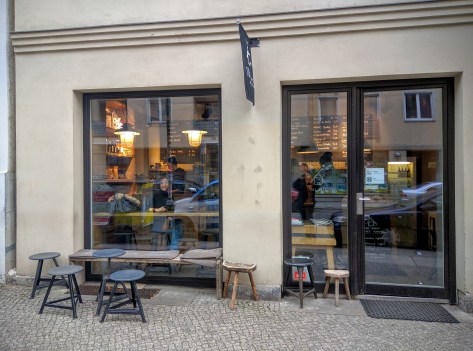
The Barn
The second place we visited was Distrikt Coffee (Bergstrasse 68, 10115 Berlin), also in the Mitte neighborhood, less than a 20 minutes walk away from The Barn and close to the Berlin Wall Memorial.
As far as we know, they do not roast the beans but use quality product from European makers, such as Workshop Coffee from the UK.
Compared to the Barn, they appear to be less specialized in coffee but offer a great variety of sweets and food, which makes them ideal for breakfast.There is more room to sit and enjoy and they offer complimentary wi-fi, which makes them popular with students, as we could verify, and generally as a place to meet and hang out.
We tried a Colombian Arabica espresso accompanied by their signature bread pudding,which formed a perfect match. The pudding itself was delicious and a wonderful side-kick to the round and decise taste of the coffee.
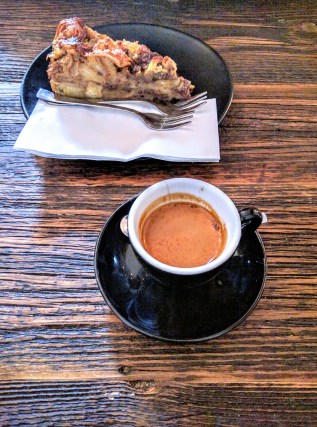
Distrikt Coffee
As a Fresh Start! :)
Coffee is a drink most of us happily enjoy every day (at least, I do 🙂 )
Some time ago I started to pay attention while enjoying, to understand which types of coffee I like most. Starting from simple the fact that, while at a café, sometimes I liked the coffee, sometimes I didn’t. From this simple fact, my curiosity started to awaken, so I started to taste different coffee at different places, to experiment.
Being a student abroad was very important, allowing me to have both freedom to spend my time at cafés and be detached enough from the local reality to experience my feelings without preconceived ideas 🙂
As a daily coffee drinker, I wanted to also share all these experiences that I am collecting in order to create my coffee diary and have the opportunity to learn more from other people during my journey.
Coffee culture has a long history behind and as I read, I can say that the journey of the coffee itself through time and space is fascinating, too. I intend to follow this evolution and learn more about it.
I hope you also enjoy when you read my explorations and I will be waiting to learn from you.
As we find written in the Adrian Johns’s Nature of the Book: ‘If we can’t share a cup of coffee, what can we share?’ 🙂
 COFFEE MAPPING